Best Stud Finders Compared for 2026: 5 Top Wall Scanners
Best stud finders compared: 5 wall scanners rated on wood, metal and live wire alerts, depth and trade-offs. Find the right one for your jobs.
5 stud finders and wall scanners compared on depth, wood and metal detection, and live wire alerts, so you can pick the right one for your trade
Hanging cabinets, blocking a TV mount, fastening drywall or running trim all start with the same question: where is the framing? Guess wrong and you end up with extra holes, a fixture that is not anchored, or a screw driven into something hidden behind the wall. A good electronic scanner answers that question in seconds, but the tools differ a lot in how they read the wall.
Four things separate them. First, how the tool finds a stud: one sensor that you calibrate and sweep, or an array of sensors that shows the whole stud at once. Second, scan depth, since thick drywall layers or plaster reduce what a tool can see. Third, whether it handles metal studs and pipes as well as wood. Fourth, the live AC wire alert, which is a helpful extra but never a substitute for shutting off power and verifying it is off.
Below you will find five stud finders and wall scanners compared on those points, with honest trade-offs for each, a clear editor’s pick, and answers to the questions buyers ask most.
| Product | Amazon rating | Best for | Link |
|---|---|---|---|
| Franklin Sensors ProSensor M210 13-Sensor Stud Finder ★ | ★ 4.6/5 (6,713) | Fast stud layout on drywall | View → |
| Stanley FatMax Stud Sensor 300 FMHT77407 | ★ 3.6/5 (332) | Budget wood and metal stud checks | View → |
| Bosch GMS 120 Wall Scanner | ★ 4.2/5 (4,339) | Studs, pipes and wiring | View → |
| Zircon MultiScanner A200 Stud Finder with Metal and Live Wire Detection | ★ 4.3/5 (846) | Studs plus metal scanning | View → |
| Zircon StudSensor A100 Stud Finder with Live Wire Detection | ★ 4.4/5 (912) | Simple edge-finding stud checks | View → |
Franklin Sensors ProSensor M210 13-Sensor Stud Finder
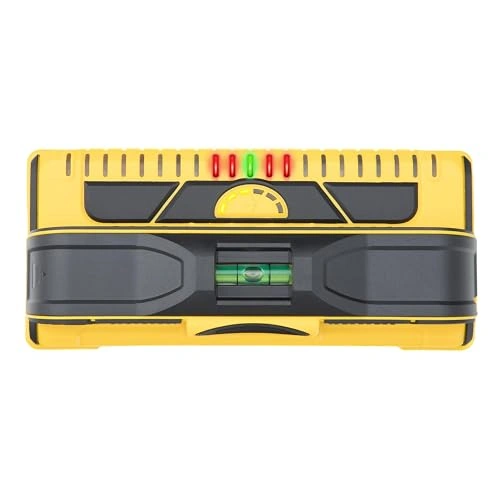
The Franklin Sensors ProSensor M210 takes a different approach from the single-sensor scanners in this group. Its 13 sensors read across a section of wall at once, and 21 LEDs show the full width of a stud, so you place the tool flat, read the pattern and mark both edges without a calibration routine. Detection depth is 1.7 inches, which suits standard drywall over wood or metal studs.
A live wire meter gives an alert near energized wiring, a built-in bubble level helps keep the tool plumb, and a pencil caddy keeps your marking pencil in reach. The trade-offs are specific. Franklin’s instructions describe the live wire meter as an indicator that may not detect every live wire, so turn power off and verify before cutting or drilling. Walls with metal lath or thick plaster are also hard for most electronic stud finders, and buyers often mention that a dedicated scanner is a better fit there.
Stanley FatMax Stud Sensor 300 FMHT77407
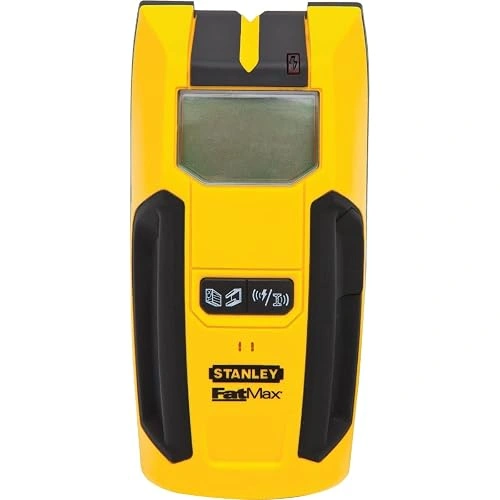
The Stanley FatMax Stud Sensor 300 FMHT77407 is a single-sensor scanner that finds wood and metal studs and warns of live AC wiring. Its scanning depth is about 1-1/2 inches for wood and metal, with an accuracy of roughly plus or minus 5 mm, and it has a backlit LCD that makes the readout easier to follow in a dim stairwell or basement. It runs on one 9V battery, which is not included.
As with other calibrate-and-sweep tools, you hold it flat, start from an open area and slide across the wall, so results depend on a steady pass and a clean start. It has no built-in level or multi-sensor array, which means it is slower than the Franklin for marking a run of studs. It is a straightforward choice from a familiar tool brand for hanging shelves and cabinets. Treat the wire alert as supplemental and shut off power before drilling.
Bosch GMS 120 Wall Scanner
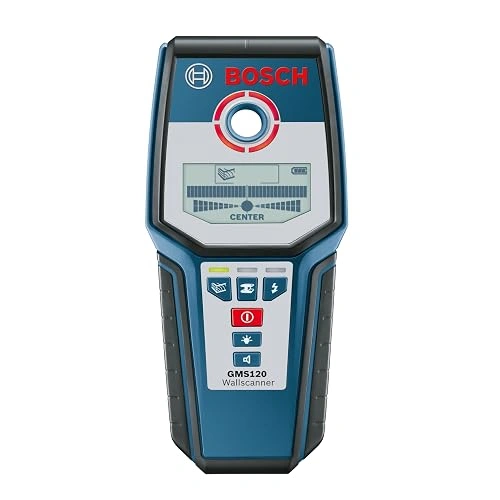
The Bosch GMS 120 is the most capable scanner of the five when the job goes beyond studs. It has three selectable modes for wood, metal and AC wiring, with automatic calibration, plus a multi-mode detection setting. Bosch lists detection of ferrous metal up to 4-3/4 inches, non-ferrous metal such as copper up to 3-1/8 inches, and live copper wiring up to 2 inches. An illuminated graphical display shows the mode and signal strength, and a status ring turns green, orange or red as you approach an object.
It includes an automatic center finder, an audible detection signal you can switch off, a 9V battery, a hand strap and a pouch. The trade-off is a bit more to learn than a pure stud finder, since you choose the right mode for the material and sweep the tool across the wall. Bosch also treats the wire alert as supplemental, so shut off power and verify before drilling or cutting.
Zircon MultiScanner A200 Stud Finder with Metal and Live Wire Detection
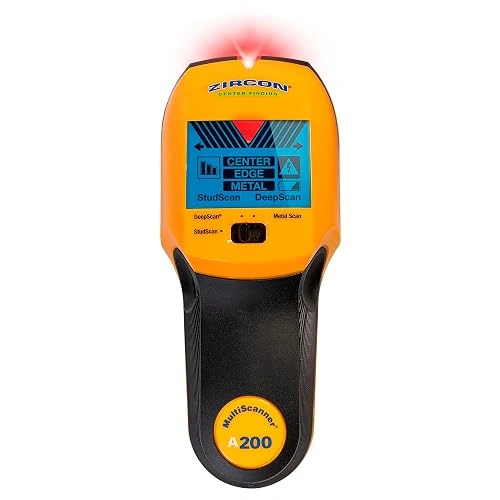
The Zircon MultiScanner A200 combines stud finding with a metal scan mode and WireWarning detection that stays active in all modes. StudScan reaches about 3/4 inch, and DeepScan extends to about 1-1/2 inches for thicker walls. Zircon states stud accuracy is typically within 1/8 inch at the shallower setting and 3/16 inch at the deeper one, which is tight enough for most layout marks. Metal scan mode is meant for finding items such as pipes and rebar, using a dual scan and mark procedure.
WireWarning alerts you to live, unshielded AC wiring up to about 2 inches deep, which is useful context before you drive a screw. Zircon notes that depth and accuracy vary with mineral content, moisture and wall texture, and that the alert is a supplement to turning power off. Buyers often mention that results take practice on textured or heavily painted walls, and the scan and mark steps are slower than an array-style finder.
Zircon StudSensor A100 Stud Finder with Live Wire Detection
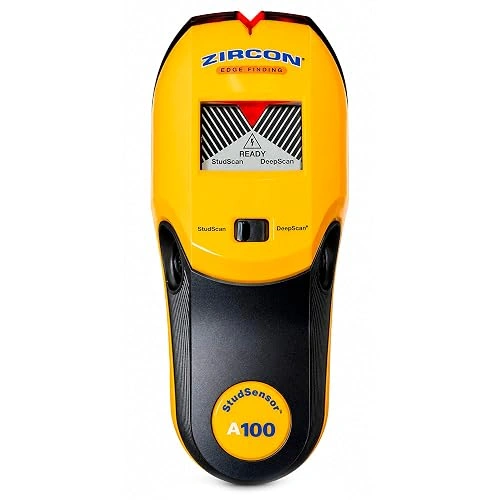
The Zircon StudSensor A100 is the simplest tool in the group. It is an edge-finding stud sensor with two scan modes: StudScan to about 3/4 inch for standard drywall, and DeepScan to about 1-1/2 inches for thicker wall surfaces. It finds both wood and metal studs, and its live wire alert works in both modes, with Zircon listing detection of unshielded wiring up to about 2 inches deep in a typical wall with Romex cable.
That makes it a sensible choice for hanging shelves, mirrors and wall-mounted storage, where you mainly want to land a fastener in framing. Because it finds the edges of a stud and you mark each one, you work out the center yourself, which takes a little more care than a tool that marks it for you. It is built around stud finding, so the A200 or the Bosch is the better fit for tracing plumbing. As with any wire alert, treat it as a supplement and verify power is off before drilling.
Conclusions
The Franklin Sensors ProSensor M210 is the best pick for most carpenters and drywall hangers. Its 13-sensor array shows a full stud width in one placement, adds a live wire meter and level, and removes the calibration step that slows other finders. … read more
The Stanley FatMax Stud Sensor 300 FMHT77407 suits homeowners and light-duty trades who want a backlit-display scanner for wood, metal and live AC wiring from a familiar brand. It is a calibrate-and-sweep tool, so it is slower than the Franklin for layout. … read more
The Bosch GMS 120 is the choice when your work includes more than studs. Its wood, metal and AC wiring modes, graphical display and center finder cover pipe, rebar and wire checks, at the cost of a little more learning than a pure stud finder. … read more
The Zircon MultiScanner A200 fits installers who want a stud finder with a real metal scan mode and WireWarning in every mode. DeepScan reaches about 1-1/2 inches, though the scan and mark routine is slower than an array-style tool. … read more
The Zircon StudSensor A100 is a straightforward edge-finding stud finder with a live wire alert for homeowners and light-duty shop use. It handles wood and metal studs to about 1-1/2 inches in DeepScan, but it is not meant for pipe or rebar tracing. … read more
Frequently Asked Questions
Can a stud finder with live wire detection make drilling safe?
No. Manufacturers describe wire alerts as supplemental and note they may not detect every live wire. Turn off power at the breaker and verify it is off before drilling or cutting into a wall, whichever scanner you use.
What is the difference between a multi-sensor stud finder and a single-sensor one?
A multi-sensor tool such as the ProSensor M210 reads a section of wall at once and lights LEDs across the full stud width, so no calibration is needed. Single-sensor tools like the Zircon models are calibrated and swept across the wall to find edges.
Which of these scanners can find metal pipes or rebar?
The Bosch GMS 120 has a metal mode listing ferrous metal to 4-3/4 inches and copper to 3-1/8 inches. The Zircon MultiScanner A200 also has a metal scan mode for items like pipes and rebar. The others are built mainly for studs.
How deep can these stud finders scan through drywall?
The ProSensor M210 lists 1.7 inches and the Stanley FatMax Stud Sensor 300 about 1-1/2 inches. The Zircon A100 and A200 reach about 3/4 inch in StudScan and about 1-1/2 inches in DeepScan. Depth varies with wall material, moisture and texture, and thick plaster can reduce it.
Do I need to calibrate each scanner before scanning a wall?
The ProSensor M210 locates the full stud width without calibration. The Bosch GMS 120 calibrates automatically after you pick a mode. The Zircon tools use a scan and mark routine, with edges found as you slide across the wall.