Best Auto-Darkening Welding Helmets Compared for 2026
Best auto-darkening welding helmets compared for MIG, stick and TIG work, with specs and trade-offs for five models. Find your fit today
Five fixed-front auto-darkening welding helmets compared on viewing area, shade range, sensors and optics so you can choose for MIG, stick or TIG
Choosing a welding helmet is harder than it looks. Every fixed-front auto-darkening model promises a clear view and fast switching, yet the details that matter in the shop, such as how big the window is, how low the shade can go for light work, and how many sensors keep the lens dark when your torch is hidden, vary from one helmet to the next.
This comparison looks at five fixed-front auto-darkening helmets that suit hobbyists, farm and garage fabricators and working professionals doing MIG, stick and TIG. The main criteria are the size of the viewing area, the shade range, the number of arc sensors and the optical clarity of the lens, with power source, grind mode and weight considered where the makers publish them.
Below you will find a short overview of each helmet with its confirmed specs and honest trade-offs, a verdict on who each one suits, an editor’s pick with the reasoning behind it, and answers to common questions about shades, batteries and sensors.
| Product | Amazon rating | Best for | Link |
|---|---|---|---|
| Lincoln Electric VIKING 3350 All American Welding Helmet ★ | ★ 4.8/5 (3,118) | All-round daily welding | View → |
| ESAB Savage A40 Auto-Darkening Welding Helmet 0700000490 | ★ 4.8/5 (93) | Budget-minded general fabrication | View → |
| Hobart 770890 Auto-Darkening Welding Helmet (Large, Black) | ★ 4.7/5 (881) | Light, simple hobby welding | View → |
| Miller Classic Series Auto-Darkening Welding Helmet ClearLight (Black) | ★ 4.6/5 (642) | Miller loyalists on a budget | View → |
| Jackson Safety W40 Insight Variable Auto Darkening Welding Helmet HaloX 40713 (Black) | ★ 4.2/5 (77) | Practical MIG and stick | View → |
Lincoln Electric VIKING 3350 All American Welding Helmet
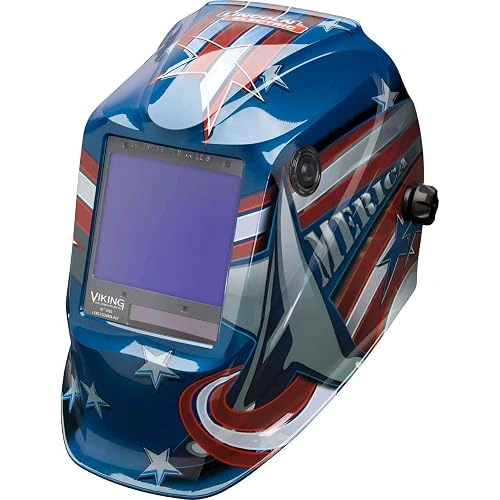
The VIKING 3350 is Lincoln’s flagship fixed-front helmet and it is built around the company’s 4C lens technology. The VIKING 3350 line has a large viewing area of about 12.5 square inches, an auto-darkening shade range of 5 to 13 and a 1/1/1/1 optical clarity rating, which is the top class on that scale.
A grind mode is selected with an external button. The wide window and low shade 5 setting make it comfortable for layout, tacking and lower-amp TIG work as well as heavier MIG and stick jobs, so it suits both serious hobbyists and daily production welders. The trade-off is that a big lens-and-shell package is not the lightest option, and the graphic design is a matter of taste.
ESAB Savage A40 Auto-Darkening Welding Helmet 0700000490
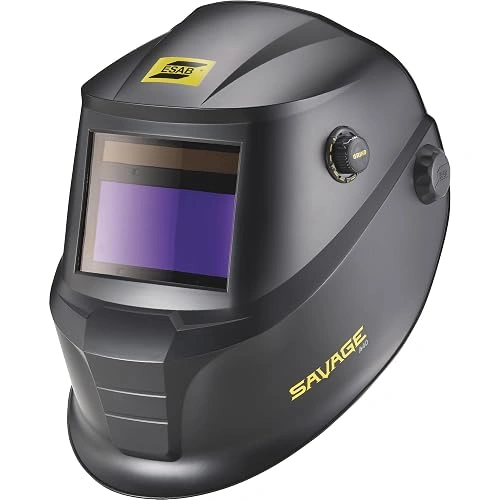
The ESAB Savage A40 in black is a straightforward fixed-front helmet aimed at welders who want a dependable lens without paying for extras. It has a 100 by 50 mm viewing area, a variable shade of DIN 9 to 13, four arc sensors and a 1/1/1/2 optical class.
Shade is set with an external control, while sensitivity and delay are adjustable from inside the helmet, which keeps those controls out of the way of gloves and dirt. The window is wider than it is tall, which gives a good side view for MIG and stick, but it is shorter than some competitors, and the shade 9 minimum means very low-amp TIG is better served by a helmet that goes lighter. It suits home shop, farm repair and light fabrication use.
Hobart 770890 Auto-Darkening Welding Helmet (Large, Black)
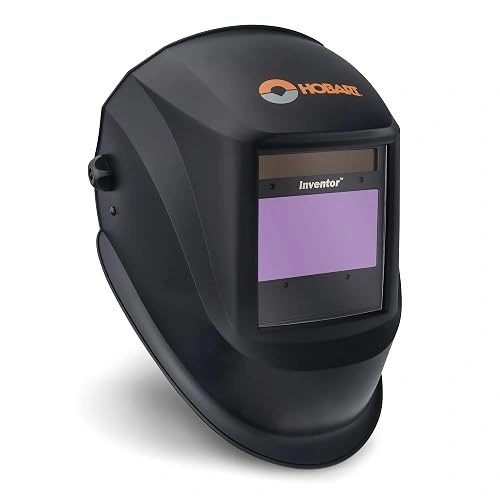
The Hobart 770890 is the black Inventor Series helmet, a simple fixed-front model that targets hobbyists and farm and garage welders. It has a 9.3 square inch widescreen viewing area, four independent arc sensors and a shade range that starts at 9.
It has a grind mode plus knob controls for shade, sensitivity and delay. The fixed shade 9 floor limits it for delicate TIG, and the controls are basic compared with helmets that offer more digital adjustment. It is a sensible choice for occasional MIG and stick work where weight and simplicity matter more than top-tier optics.
Miller Classic Series Auto-Darkening Welding Helmet ClearLight (Black)
The Miller Classic Series is the maker’s value-oriented fixed-front helmet, and this version is fitted with the ClearLight lens, which is designed to give a brighter, more neutral view of the work than a traditional filter. It is a variable-shade design with weld shades 8 to 13, cut shades 5 to 8 and a grind shade of 3.
It suits welders who value the Miller name, familiar controls and a lens that makes it easier to see the puddle edges and surrounding material. The trade-off is that the Classic Series is positioned below Miller’s premium digital helmets, so it has fewer adjustment options and is not the pick for very demanding TIG or all-day production use. It is a good fit for MIG and stick in a home or small shop.
Jackson Safety W40 Insight Variable Auto Darkening Welding Helmet HaloX 40713 (Black)
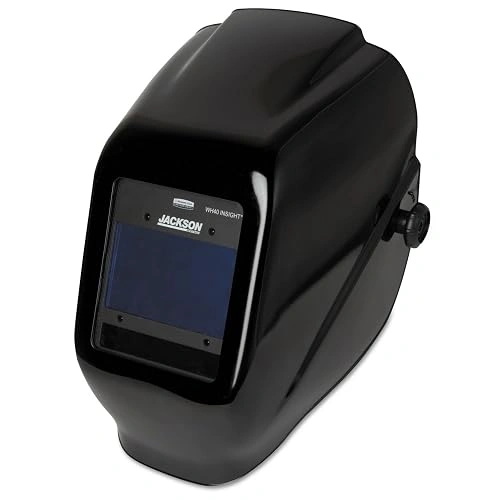
The Jackson Safety W40 Insight pairs a lightweight HaloX shell with the Insight variable auto-darkening filter. It has a viewing area of about 3.94 by 2.36 inches, a variable shade of 9 to 13 and digital controls.
The Insight filter also fits other Jackson shells, which is handy if you later want a different shell style. For welders it is a practical, no-nonsense helmet for MIG and stick at the bench or on site, with enough adjustment to match different amperages and ambient light. The limits are similar to the rest of this group: a shade 9 minimum is not ideal for low-amp TIG, the window is average in size, and the headgear is basic. It suits hobbyists and tradespeople who want a familiar Jackson filter at a modest level of features.
Conclusions
The Lincoln Electric VIKING 3350 All American is the best fit if you weld often and want the widest view, a shade 5 low end and top-class 1/1/1/1 optics. It is the strongest all-rounder here, with the usual weight trade-off of a large helmet. … read more
The ESAB Savage A40 0700000490 is a solid choice for home shops and light fabrication. It offers four sensors and internal sensitivity and delay controls, though the shade 9 minimum limits very low-amp TIG. … read more
The Hobart 770890 suits occasional welders who want a light, simple helmet with a taller window than the ESAB. Choose it for MIG and stick around the farm or garage, and look elsewhere for precise low-amp TIG. … read more
The Miller Classic Series ClearLight is a good option if you prefer Miller and want the brighter, more neutral ClearLight lens. It is aimed at MIG and stick in a home or small shop rather than demanding production work. … read more
The Jackson Safety W40 Insight HaloX 40713 gives MIG and stick welders a light shell and sensitivity and delay adjustment. It works well for general work, but its shade 9 floor makes it a weaker match for delicate TIG. … read more
Frequently Asked Questions
Which helmet here works best for low-amp TIG welding?
The Lincoln Electric VIKING 3350 is the best match because its range starts at shade 5, while the ESAB, Hobart and Jackson helmets start at shade 9. Low-amp TIG gives a dim arc that a darker minimum shade can hide.
What does a 1/1/1/1 optical class mean on a welding helmet?
The four numbers rate optical clarity, light diffusion, variations in luminous transmittance and angle dependence. A 1 is the best score in each category. The Lincoln VIKING 3350 is rated 1/1/1/1 and the ESAB Savage A40 1/1/1/2.
Why do some helmets have four arc sensors instead of two?
More sensors help the lens detect the arc when your torch, hand or workpiece blocks one of them, such as in awkward positions. The ESAB Savage A40 and Hobart 770890 here have four sensors.
Do these helmets have a grind mode?
Yes. The Lincoln VIKING 3350 has an external grind button, the Hobart 770890 has a grind mode and the Miller Classic has a grind shade of 3. Grind mode keeps the lens from darkening while you work with a grinder.
What batteries do these auto-darkening helmets use?
Auto-darkening helmets use a small replaceable cell, often with solar assist, so the battery type varies by model. Keep a spare cell on hand so a dead battery does not stop a job, and check the maker's manual for the exact type.